It is the summer of 1977 in the South Bronx, and a sixteen-year-old named Kenneth Gabbert -- soon to be known as Ken Swift -- watches a circle of dancers in a park. A boombox blasts James Brown's "Get on the Good Foot." One by one, dancers drop to the ground, spinning on their backs, freezing in impossible poses, then springing upright to let the next person enter the cipher. Nobody has a name for what they are doing yet, but within a few years the world will call it breakdancing -- and it will become the most visible branch of a vast, interlocking family of street dance forms.
Origins: Concrete Stages and Community Ciphers
Street dance is not one style but a constellation of forms born outside of studios and academies, in parks, housing projects, block parties, and nightclubs. Its deepest American roots lie in the African American and Latino communities of New York City during the 1960s and 1970s. DJ Kool Herc's legendary back-to-school party at 1520 Sedgwick Avenue in the Bronx on August 11, 1973, is often cited as the founding moment of hip-hop culture, and dance was one of its four pillars from the beginning (alongside DJing, MCing, and graffiti).
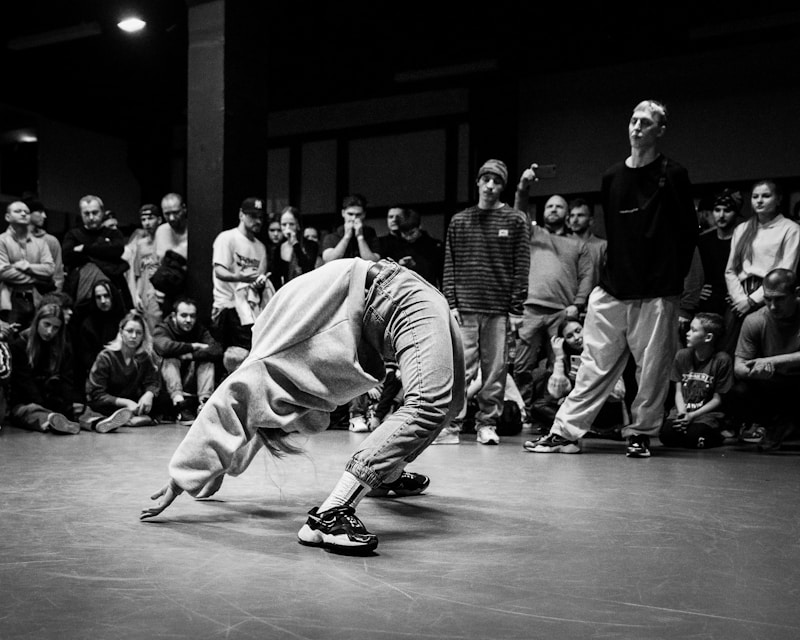
Breaking -- the proper name for what the media called "breakdancing" -- was the first street dance style to achieve global recognition. Pioneers like the Rock Steady Crew (founded 1977) and the New York City Breakers developed a vocabulary of toprock (standing moves), downrock (floor work), power moves (spins and rotations), and freezes (held poses). The dance was intensely competitive: crews battled for reputation at jams, with the cipher (circle of spectators) serving as both stage and jury.
Simultaneously, different street dance traditions were evolving on the West Coast. In Los Angeles, locking was invented around 1969 by Don Campbell, who created the style's signature freezes and points after failing to keep up with a popular dance called the Funky Chicken. His group, The Lockers, brought the style to national TV via Soul Train in the early 1970s. Popping, developed by Sam Solomon (Boogaloo Sam) and his Electric Boogaloos in Fresno, California, around 1975-1978, used rapid muscle contractions to create an illusion of the body "hitting" or robotically isolating. Together, locking and popping formed the West Coast "funk styles" -- distinct from breaking but equally innovative.
Global Spread and New Generations
The early 1980s brought street dance to mass audiences. The films Wild Style (1983), Beat Street (1984), and Breakin' (1984) transmitted breaking worldwide. Suddenly, kids in Tokyo, Paris, and Sao Paulo were spinning on cardboard in shopping malls. In France, a particularly vibrant scene developed: the crew Aktuel Force began competing in the mid-1980s, and France today hosts some of the world's most prestigious battles, including Juste Debout (founded 2002) and the Red Bull BC One world finals.
The 1990s and 2000s saw the emergence of new street dance styles rooted in club culture. Vogueing, born in Harlem's Black and Latino LGBTQ+ ballroom scene in the 1960s and popularized by Jennie Livingston's documentary Paris Is Burning (1990), developed into distinct categories -- Old Way, New Way, and Vogue Femme -- each with its own technical demands. Krumping erupted in South Central Los Angeles in the early 2000s, with dancers like Tight Eyez and Big Mijo channeling raw emotion into aggressive, hyper-energetic movement. And Afro dance styles -- from Azonto (Ghana) to Coupé-Décalé (Ivory Coast) to South Africa's Amapiano moves -- circulated globally through social media, reshaping what "street dance" means beyond the American context.
Lasting Legacy
In 2024, breaking made its debut as an Olympic sport at the Paris Games -- a milestone that would have seemed absurd to the Bronx teenagers who invented it in burned-out lots fifty years earlier. But the real legacy of street dance is not institutional recognition; it is the democratic principle at its core. You do not need a studio, a teacher, or tuition to enter a cipher. You need a body, a beat, and the courage to express yourself. That radical accessibility is why street dance continues to evolve faster than any academy can codify it, and why its influence saturates pop music choreography, fashion, and visual culture around the world.