It is 1952 in Havana's Tropicana nightclub, and the house orchestra launches into a mambo so fast the horn section seems to blur. On the open-air dance floor, surrounded by tropical foliage and arching concrete canopies, couples execute razor-sharp turns and syncopated footwork while singer Benny More improvises over the band. In the audience, an astonished Marlon Brando watches a culture he will later say "made every American nightclub look dead." Cuba's gift to the world's dance floors is reaching its zenith -- and it is only the beginning of a Latin dance explosion that will reshape social dancing on every continent.
Origins: African Rhythms Meet European Forms
Latin dance is not a single tradition but a family of forms born from the collision of African, European, and Indigenous cultures across the Caribbean and South America. The engine of this fusion was the slave trade. Between the 16th and 19th centuries, millions of West and Central Africans were forcibly brought to the Americas, carrying with them polyrhythmic drumming traditions, call-and-response singing, and movement vocabularies rooted in bent knees, earthward orientation, and hip articulation -- qualities that remain the defining DNA of Latin dance today.
In Cuba, the son -- a musical and dance form blending Spanish guitar patterns with Afro-Cuban percussion -- emerged in the eastern Oriente province in the late 19th century and reached Havana by the 1920s. The son gave birth to a dynasty: the mambo (popularized by Perez Prado in the late 1940s), the cha-cha-cha (invented by Cuban violinist Enrique Jorrin in 1953), and eventually salsa, which crystallized among Puerto Rican and Cuban musicians in 1960s-70s New York. Fania Records, founded by Johnny Pacheco and Jerry Masucci in 1964, became salsa's Motown, launching artists like Celia Cruz, Hector Lavoe, and Willie Colon into international fame.
Brazil contributed its own parallel tradition. Samba's roots lie in the batuque circle dances of enslaved Angolans and Congolese in Bahia, which blended with Portuguese maxixe partner dancing in Rio de Janeiro in the early 20th century. By 1917, when Donga recorded "Pelo Telefone" -- often cited as the first samba recording -- the genre was already inseparable from Rio's Carnival. Samba de gafieira, the partnered social form danced in Rio's dance halls, combines ballroom-like elegance with distinctly Afro-Brazilian hip movement and improvisation.
The Global Spread
The post-World War II era saw Latin dance forms sweep through the United States and Europe. The mambo craze hit New York's Palladium Ballroom in the late 1940s, where dancers like Pedro "Cuban Pete" Aguilar and Millie Donay dazzled crowds with acrobatic partnering. The Palladium -- located at the corner of Broadway and 53rd Street -- became the "Home of the Mambo" and a rare integrated space in segregated-era Manhattan.
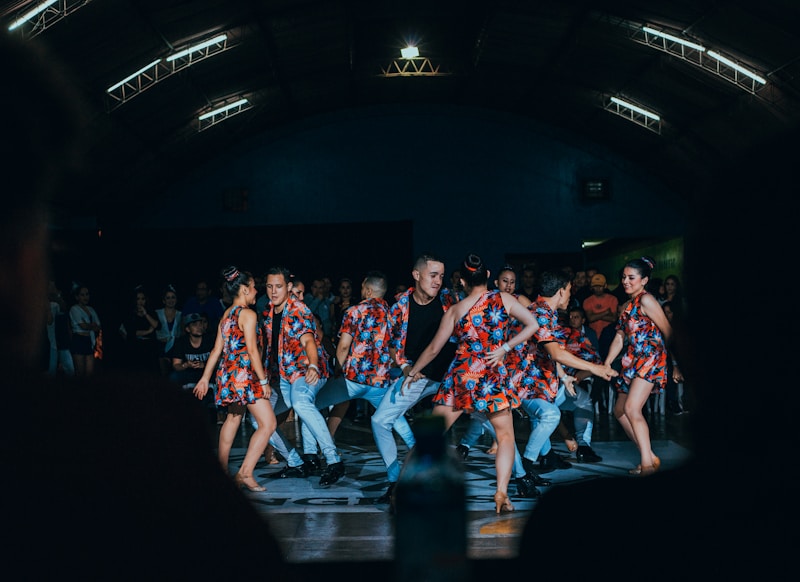
In the 1990s, a second explosion occurred. Salsa congresses -- multi-day festivals combining workshops, performances, and social dancing -- proliferated worldwide, with events in Los Angeles, London, Sydney, and Tokyo drawing thousands. The LA-style and New York-style salsa schools developed distinct aesthetics: LA emphasized flashy performance tricks and danced "on 1," while New York (mambo) style, championed by Eddie Torres, danced "on 2" with a smoother, more Afro-Cuban feel.
Meanwhile, other Latin forms found their own global audiences. Argentine tango, after near-extinction in the mid-20th century, was revived by the Broadway show Tango Argentino (1985) and now sustains a worldwide network of milongas (social dance events). Bachata, born in the rural bars of the Dominican Republic in the 1960s as the music of the poor, evolved from a simple two-step into the sensual, body-wave-inflected form popularized by dancers like Ataca and La Alemana in the 2010s. Reggaeton and its associated perreo dancing, rooted in Puerto Rican and Panamanian dancehall culture, became a dominant global pop force by the 2020s through artists like Daddy Yankee, Bad Bunny, and J Balvin.

Lasting Legacy
Latin dance has done something remarkable: it has made partner dancing relevant to young people in an era dominated by solo movement. Walk into a salsa social or a bachata night in any major city on Earth, and you will find people in their twenties and thirties learning to lead and follow, to listen to music with their bodies, and to connect physically with a stranger in a way that no dating app can replicate. The Afro-Caribbean rhythmic traditions that gave birth to these forms have become, in a very real sense, the common language of global social dance.