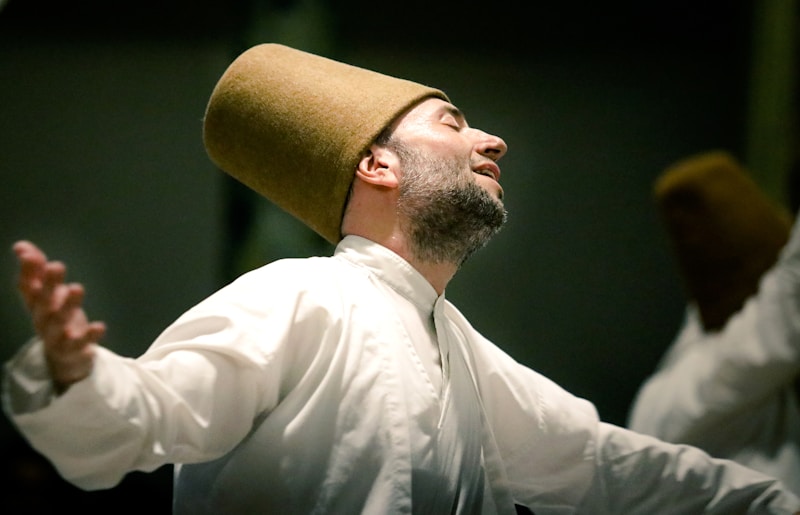
In the city of Konya, in central Turkey, on a December evening in 1273, the followers of the poet and mystic Jalal ad-Din Muhammad Rumi gathered to mourn his death. According to tradition, they began to turn -- slowly at first, then with gathering speed, one hand raised toward heaven and the other extended toward the earth, white robes fanning outward like opening flowers. This was the sema, the whirling ceremony of the Mevlevi order, and for seven and a half centuries it has continued as one of the world's most recognizable expressions of dance as prayer.
Origins: The Body as Sacred Instrument
The impulse to worship through movement predates every organized religion. Archaeological evidence from Catalhoyuk in Anatolia (c. 7500 BCE) shows figures in what appear to be ecstatic dance postures. The Hebrew Bible describes King David dancing "with all his might" before the Ark of the Covenant (2 Samuel 6:14, c. 1000 BCE). In Hindu tradition, the god Shiva is Nataraja -- the Lord of Dance -- whose cosmic tandava creates and destroys the universe in an eternal cycle. The bronze Nataraja statue from the Chola dynasty (c. 11th century CE) remains one of the most iconic images in all of art.
Each tradition developed its own grammar of sacred movement. In West Africa, the Yoruba people of present-day Nigeria and Benin perform possession dances for the orishas -- deities like Shango (thunder) and Oshun (river, love) -- in which the dancer's body becomes a vessel for divine presence. These traditions traveled across the Atlantic with enslaved Africans and survived in the candomblé ceremonies of Brazil, the vodou rituals of Haiti, and the ring shouts of the American South, where worshippers moved counterclockwise in a shuffling circle, singing call-and-response spirituals that would eventually feed into gospel music and jazz.
Sacred Dance Across Traditions
In the Christian world, dance has had a complicated history. The early church fathers were deeply suspicious of bodily movement in worship, associating it with pagan ritual. Yet dance persisted at the margins. In Ethiopia, the aquaquam -- a liturgical dance performed by priests and deacons with prayer sticks and sistra -- has been part of the Ethiopian Orthodox Tewahedo Church since at least the 6th century and continues today. In medieval Spain, the Seises of Seville Cathedral have danced before the altar during Corpus Christi since at least 1439, a tradition that required a special papal dispensation to survive the Counter-Reformation.
Buddhism, too, has its dance traditions. The cham dances of Tibetan Buddhism, performed by monks wearing elaborate masks representing wrathful deities and protective spirits, serve as both meditation practice and public teaching. At the annual Tsechu festivals in Bhutan, these masked dances attract entire communities; simply watching is believed to bring spiritual merit. In Japan, the gagaku court dances preserved at Shinto shrines since the 8th century are among the oldest continuously performed choreographic traditions in the world.
Indigenous Australian peoples have danced their Dreamtime stories for at least 50,000 years, making their ceremonial dances arguably the oldest living performance tradition on Earth. The corroboree -- a gathering involving song, dance, and body painting -- transmits creation narratives, law, and ecological knowledge through precisely choreographed movements that are understood as reenactments of ancestral events.

Lasting Legacy
In the modern secular world, the connection between dance and spirituality has not vanished -- it has migrated. The ecstatic trance states sought in a Sufi sema or a Yoruba possession ceremony find echoes in the peak experiences described by ravers, contact improvisation practitioners, and participants in the global 5Rhythms movement founded by Gabrielle Roth in the 1970s. Neuroscience research confirms what mystics have long known: rhythmic movement can alter consciousness, suppress the brain's default mode network, and produce states of self-transcendence.
The sacred dance traditions of the world remind us that before dance was entertainment, before it was art, before it was exercise, it was communion -- a way of using the body to touch something beyond the body. That impulse remains as powerful today as it was in the torchlit temples of antiquity.