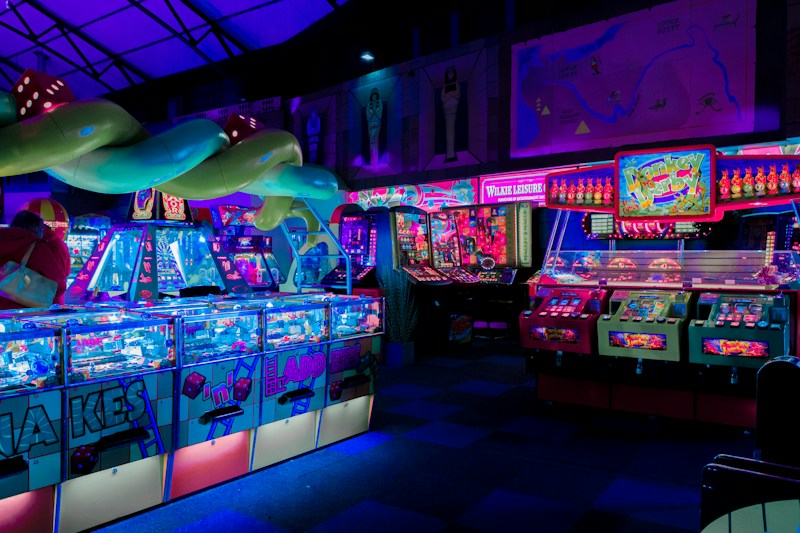
It's 1998 and you're standing on a metal platform at the arcade, arrows flying up the screen, your feet hammering in patterns you've drilled for weeks. Dance Dance Revolution has turned you — a kid who would never set foot in a dance class — into a performer, sweating and smiling while a crowd gathers behind you. Konami's rhythm game didn't just sell cabinets. It proved that dance and gaming were a natural, joyful marriage.
From Arcades to Living Rooms
Dance Dance Revolution (DDR) launched in Japan in 1998 and hit North American arcades in 1999. The concept was elegant: a four-panel floor pad, arrows scrolling upward, stomp the right direction at the right time. Easy to understand, brutally hard to master. At its peak, competitive DDR players moved with a speed and precision that genuinely qualified as athletic dance, and tournaments drew thousands. The game was even adopted by some schools as a physical education tool.
DDR's success spawned imitators and evolutions. Pump It Up (1999) added a center panel and diagonal arrows for more complex footwork. In the Groove (2004) pushed difficulty ceilings even higher. But the genre's true mainstream explosion came with Just Dance (2009) by Ubisoft.
Just Dance stripped away the floor pad entirely. Using the Wii Remote's motion sensor (and later phone apps and cameras), players mimicked on-screen dancers performing choreography to pop songs. It was immediately, wildly accessible — your grandma could play it at Christmas. The franchise has sold over 80 million copies across 14+ annual entries, making it one of the best-selling game series of all time. Songs like "Rasputin," "Blinding Lights," and "Don't Start Now" have official choreography that millions of players know by heart.
Dance Central (2010) by Harmonix used the Xbox Kinect camera to track full-body movement, offering a more serious dance experience. Its choreography, designed by real dancers including Marcos 'Kosmo' Aguirre and Frenchy Hernandez, bridged the gap between casual gaming and actual dance training.
Dance as Game Mechanic Beyond Rhythm Games
Dance doesn't just live in dedicated rhythm games. Fortnite transformed dance into a core social mechanic with its emote system. The "Default Dance," "Floss," "Orange Justice," and dozens of other moves became how players celebrated, taunted, and communicated. At its peak, Fortnite emotes were more culturally ubiquitous than any dance craze since the Macarena.
This wasn't without controversy. Alfonso Ribeiro (the "Carlton Dance" from Fresh Prince), Backpack Kid (the "Floss"), and 2 Milly ("Milly Rock") all accused Epic Games of profiting from their signature moves without credit or compensation. The lawsuits largely failed due to U.S. copyright law's difficulty with protecting short dance sequences, but they echoed the same credit conversations happening on TikTok.
Beyond emotes, dance appears as narrative and mechanical elements across gaming. The Persona series features elaborate dance-themed spinoffs (Persona 4: Dancing All Night). Final Fantasy XIV has an entire dance job class and elaborate player-choreographed performances. Crypt of the NecroDancer fuses dungeon crawling with rhythm-based movement. Even The Legend of Zelda: Majora's Mask used dance as a gameplay mechanic for transforming between forms.
The Social Dance Floor
What video games uniquely contribute to dance culture is the removal of self-consciousness. Dancing in public is terrifying for most people. Dancing in your living room with a screen telling you exactly what to do? That's play. Games give people permission to move their bodies without judgment, and research consistently shows that rhythm games improve coordination, timing, and even cardiovascular fitness.
The competitive scene is thriving too. DDR tournaments continue at events like Konami Arcade Championship. Just Dance has an official World Cup organized by Ubisoft, with regional qualifiers and a global final. Dance Central spawned community meetups that functioned like informal dance crews.
Looking forward, VR dance games like Beat Saber (which is rhythm-based movement if not traditional dance) and Synth Riders are adding full-body immersion to the formula. As motion capture improves and VR headsets get lighter, we're heading toward a world where your avatar dances exactly as you do — bringing the arcade magic of DDR into a fully three-dimensional virtual dance floor.